
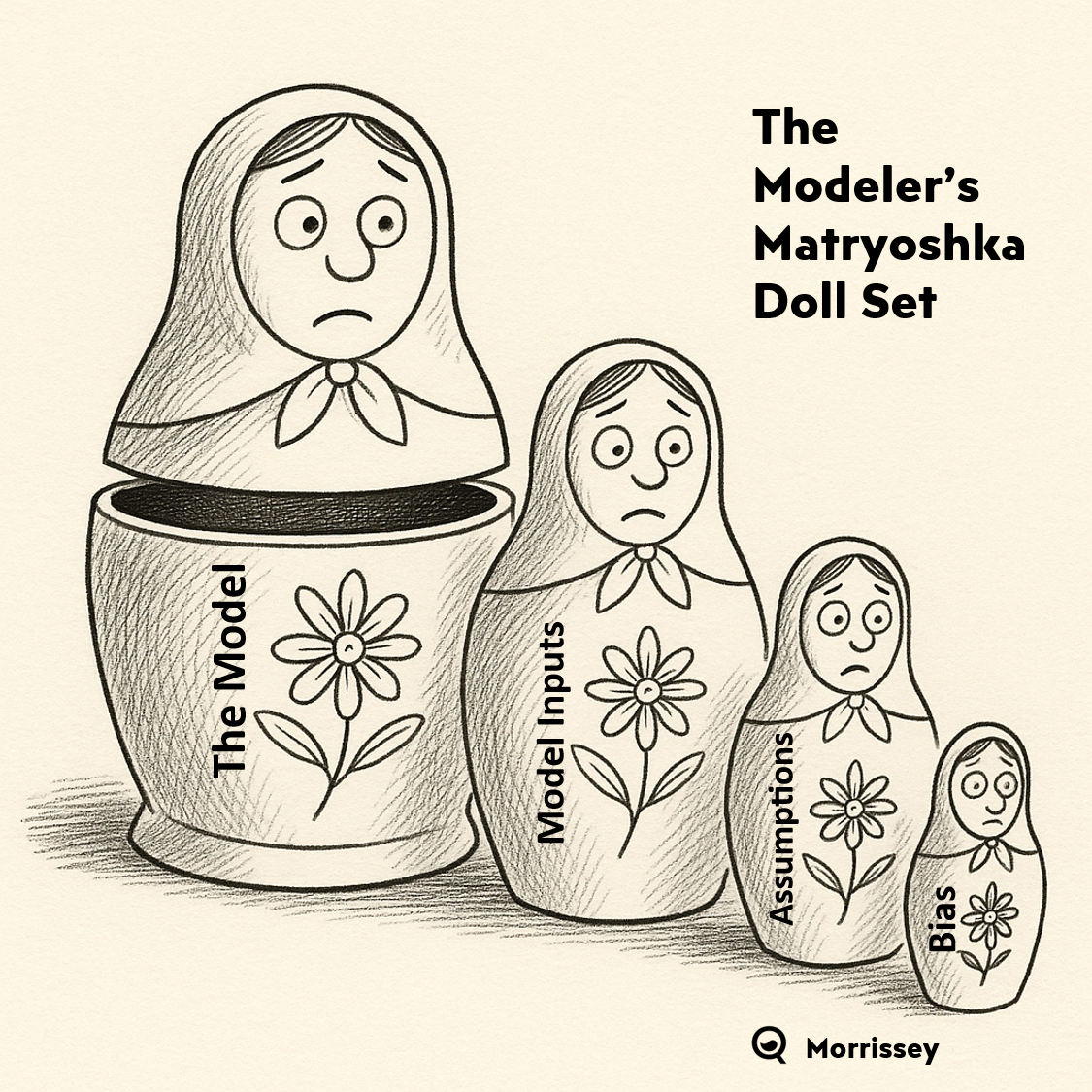
When most people think about mathematical models, they imagine cold, hard calculations. Precision. Objectivity. Certainly not values or judgment. But in practice, every model is a reflection of human choices. And those choices are deeply shaped by values, whether we admit it or not.
This isn’t just a philosophical point. In groundwater modelling, it has real-world implications. Whether you’re simulating an aquifer to support a permit application, plan a water supply, or analyze contamination risk, your groundwater model tells a story. And like any story, it’s shaped by decisions about what to include, what to leave out, and what counts as “good enough.”
Math Modelling is Biased
Let’s say you’re building a groundwater model. You face a series of decisions: steady-state or transient simulation? 2D or full 3D representation? How much detail to include in representing subsurface heterogeneity and hydraulic conductivity? These decisions aren’t purely technical. They involve trade-offs between the model’s intended purpose, the potential consequences of acting on its results, the time available, financial constraints, and the quality and quantity of available data.
Even choices like defining boundary conditions and initial conditions, setting model boundaries, or selecting calibration targets carry implicit value judgments. Is it better to include the entire watershed or focus narrowly on part of it? Where should the bottom of the model be placed? Do you prioritize matching hydraulic heads, groundwater flow, fluxes, or travel times? Each choice emphasizes different system features and may advantage or disadvantage particular stakeholders. All these decisions reflect what the modeler considers most important or most at risk.
The Problem with “Neutrality”
Because groundwater models are built on assumptions and simplifications, they are never perfect representations of reality. But when models are treated as neutral or purely objective, we risk ignoring the values embedded within them. This can lead to a false sense of certainty and potentially biased decision-making.
Consider a mining site where a pit is proposed adjacent to a river. Two groups may need a groundwater model for very different purposes: a geotechnical engineering team assessing slope stability and a hydrology team evaluating potential impacts on river flow. For the geotechnical team, the model might use highly conservative assumptions to ensure safety by overestimating groundwater levels and potential inflow to the pit. While this approach helps safeguard slope design, it may significantly overstate how much ground water would discharge from the river into the pit, leading to potentially exaggerated concerns about river depletion. Conversely, if the model is built primarily to understand the potential impact on streamflow, conservative assumptions about groundwater levels and inflow to the pit may distort the analysis. In this case, the hydrology team could draw misleading conclusions about the threat to the river. Each model, though technically sound in its own domain, embeds value-driven choices that reflect differing priorities and may not be neutral from the perspective of other stakeholders.
A More Reflective Modelling Practice
Recognizing that groundwater modeling software and its outputs are not neutral doesn’t mean we should abandon them. Far from it. It means we must be more transparent, more deliberate, and more inclusive in how we build and use them.
Good modelling practice involves clearly documenting assumptions, exploring alternative scenarios, and being upfront about uncertainties. It also involves engaging with the stakeholders to ensure that the model reflects the appropriate range of perspectives and concerns.
This reflective approach turns groundwater modeling from a purely technical task into a richer, more accountable process. It encourages us to treat models as tools for exploration and dialogue, not just as prediction engines.
Iterative and Transparent Modelling with Anaqsim
Anaqsim is a powerful groundwater modeling software platform designed for both 2D and 3D simulations, in steady-state or transient conditions. While capable of handling complex systems, what makes Anaqsim particularly valuable in a reflective modelling context is how easily it supports exploration and iteration.
Because Anaqsim uses the analytic element method and is mesh-free, modellers can rapidly construct and revise models from scratch. This mesh-free approach offers significant flexibility and helps reduce computational overhead without sacrificing clarity or performance. It allows for the creation of multiple models that represent different scenarios, stakeholder perspectives, or conceptual frameworks. Instead of relying on a single “best estimate,” modellers can use Anaqsim to compare outcomes across a range of assumptions.
This approach makes it easier to identify patterns and explore the consequences of different choices. These types of insight can be far more accessible to non-specialists than a single model output or a narrow range of results. By showing how results shift with assumptions, Anaqsim helps make model-based reasoning more transparent and understandable.
In this way, Anaqsim becomes more than just a simulator. It’s a tool for dialogue, insight, and decision-making in groundwater problems.
Final Thoughts
The next time you build or interpret a groundwater model, pause to consider the values that shape it. What story does the model tell? What choices lie beneath the surface? And how can we, as modelers, use our tools not just to simulate reality, but to engage with it as a tool for thinking.
Because there’s no such thing as an unbiased model. And recognizing that is the first step toward building better ones.